
Paying Attention Is Where Leadership Begins
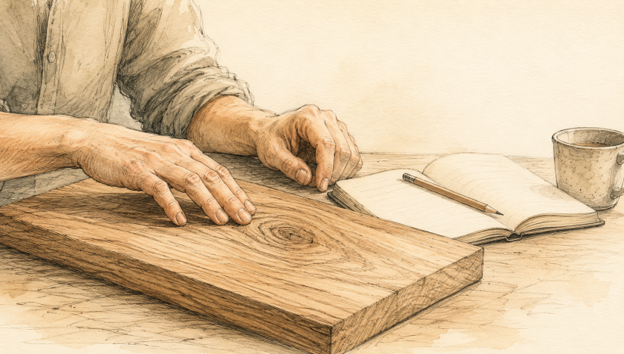
This illustration was created with the assistance of ChatGPT, OpenAI, from a prompt developed by CCLA. It is close to home for us: one of our colleagues is an avid woodworker. His craft offers a helpful reminder that shaping begins with careful attention
Most leadership doesn’t begin with a speech, a strategy, or a formal decision.
It begins with noticing.
Noticing what’s happening.
Noticing what’s being said and not said.
Noticing where energy rises or falls.
Noticing when someone is present, distracted, confused, discouraged, resistant, curious, or ready.
These are some of the reasons why we’re beginning this next blog arc with a deceptively simple theme:
Paying attention.
At first glance, paying attention may sound like something small. Almost ordinary. Something we ask children to do in school. Something we remind ourselves to do in meetings. Something we assume we are already doing.
But paying attention isn’t passive.
It’s one of the first acts of leadership.
It’s how we make contact with reality before rushing to interpretation, advice, correction, or action. It’s how we begin to understand what a situation is actually asking of us.
The woodworking image above gives us one way to think about this.
Before cutting, shaping, sanding, or joining, a skilled craftsperson pauses long enough to see what ’s already there: the lines, knots, tensions, strengths, irregularities, in the grain of the wood. The goal is not to force the wood into a preferred form before understanding it. The goal is to work with the material as it actually is.
Leadership works much the same way.
Before we intervene, decide, correct, persuade, encourage, redirect, or explain, we need to see the actual condition in front of us. We need to notice the grain of the situation.
What’s happening here?
What’s the mood in the room?
Where’s the energy?
Where’s the hesitation?
What’s being avoided?
What’s trying to become clear?
Paying attention helps us respond to the situation we actually have, not the one we assumed, preferred, or named too quickly.
And in that sense, paying attention is not merely observation. It’s the beginning of skilled action.
This Friday’s Field Note comes from a friend of CCLA whose life has carried her through several forms of service: convent life, elementary education, and years of close attention to children and learning. Now 90 years old, she offers a story about tutoring a bright seven-year-old who couldn’t seem to pay attention during their sessions.
Her story isn’t, on the surface, a “business leadership” story.
That may be exactly why it belongs here.
One of the things readers have told us about Leadership Actually is that its usefulness does not stop at formal leadership roles. The book speaks to managers, yes. But it also speaks to parents, teachers, coaches, volunteers, colleagues, friends, and anyone who wants to become more skilled in the human work of interaction and relationship.
That’s because leadership, as we understand it, is not merely a position. It is a lived practice.
It happens in the space between people.
It happens when one person pays close enough attention to another to notice what’s really going on, not merely what appears to be happening on the surface.
In this week’s Field Note, our friend’s tutoring sessions could easily have become a familiar story: an adult trying hard to get a child to comply, focus, sit still, or “do the work.”
But there was a deeper leadership move that began with curiosity.
What’s actually happening here?
What’s this child showing me?
What am I missing?
Those questions matter because paying attention changes the field of action. It slows down our assumptions. It helps us see the person in front of us, not simply the problem we’ve named. It allows a different kind of response to become possible.
That’s skilled leadership knowledge in ordinary form.
But ordinary doesn’t mean small.
Much of leadership is practiced in ordinary moments: a conversation, a pause, a question, a look across the table, a decision not to react too quickly, a willingness to notice the human reality beneath the surface behavior.
When we fail to pay attention, we tend to reach for familiar explanations. We label the person. We blame the situation. We repeat the same strategy with more intensity. We try to solve the wrong problem.
When we do pay attention, we create the possibility of a better response.
A teacher may see the learner differently.
A manager may hear what the team has been trying to say.
A parent may notice the feeling underneath the behavior.
A colleague may sense the hesitation behind someone’s silence.
A leader may recognize that the real issue isn’t resistance, but confusion, fatigue, fear, unclear expectations, lack of shared meaning or simply not understanding what the person in front of you needs.
This is why paying attention is not a soft skill in the dismissive sense of that phrase. It’s a core human capability.
It’s also a discipline.
Attention can be trained. It can be practiced. It can be strengthened through reflection, curiosity, patience, and the willingness to stay with what is actually happening before deciding too quickly what it means.
That discipline sits at the heart of Leadership Actually and our work at the Co-Creative Leadership Alliance.
Leadership becomes more real when we become more attentive to the living situation in front of us.
Not the abstract situation.
Not the idealized situation.
Not the situation we wish we had.
The actual one.
This week, as we begin the “Paying Attention” arc, we invite you to consider where attention is already shaping your leadership, learning, and relationships.
Where might you be moving too quickly?
Where might you be naming the problem before seeing the person?
Where might a better response begin with a better act of noticing?
Because sometimes the first leadership move is not to direct, decide, or explain.
Sometimes the first leadership move is to just pay attention.
The Co-Creative Leadership Alliance (CCLA)
Exploring leadership as a lived experience—where insight emerges from practice, reflection, and shared learning.