
After Adoption
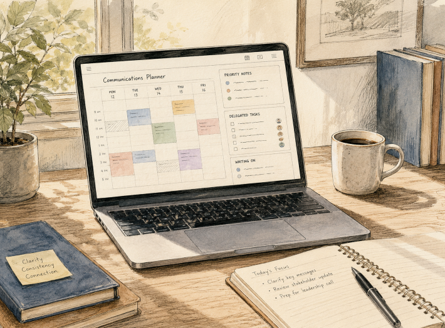
Illustration created with the assistance of ChatGPT from a prompt developed by CCLA.
By C.R.
Now, a month and a half after AI was introduced, the question isn’t whether we’re using AI.
It’s how far it’s already gone.
For example, I now use it daily. Weekdays and weekends. For work and for personal things. And it still feels like I’ve barely scratched the surface of what this amazing tool can do.
At some point, it stopped being something I tried to use and became something I naturally reach for.
That shift didn’t happen by accident. Part of it is what I’ve built for myself.
I now have an AI agent that pulls from my email, Slack, my calendar, and the notes I write at the end of each day—and turns it all into a daily communications planner: what matters most, what can be delegated, what I’ve committed to, and what I’m still waiting on.
It’s remarkably good, but what’s happening with me individually is only part of the story. At the organizational level, something more deliberate has taken shape.
We now use two AI platforms. On the second, our CEO introduced a set of shared “skills”—including a project memory capability and structured instructions tied to how we work as a company. When we installed them, he referred to them as company standards.
That landed.
Not because of the technical setup, but because of what it signaled.
This isn’t just about using AI.
This is about how we use it—together.
The effect has been immediate.
Everyone is using it. People are sharing what they’re learning. Outputs are circulating. Information availability has skyrocketed.
And this is where the earlier signal starts to compound—what started as permission has now begun to shape how we work.
If the first phase was about getting started, this phase is about getting better.
What felt like a push at first now feels like it’s just the way we work.
You can feel that happening. Not abstractly. Practically.
What started as permission… then became expectation… has now turned into shared practice.
AI has all but stopped being only an individual productivity tool. It’s starting to feel like this is how we work.
It’s not perfect. Not complete. But nonetheless, visible.
Looking back, the progression is clearer now:
First, AI was legitimized. Then, it became something we were charged with learning and using in our work. Now, as it scales, it’s shaping how we work.
It’s difficult not to admire the way this has all come about through the application of visible, “decisive, and value-adding leadership” as Elliott Jaques used to say*.
And that progression has resulted in people developing fluency in a capability that’s going to have a hand in shaping all of our futures, making it equally difficult to go back to working the old way.
C.R. is a senior leader inside a large global organization, writing from the lived experience of introducing, adopting, and integrating AI in real time.
*Executive Leadership: A Practical Guide to Managing Complexity by Elliott Jaques and Stephen D. Clement, 1994. Blackwell Publishing. Oxford,UK and Victoria, Australia