
What Happens When AI Shows Up in the Command Post
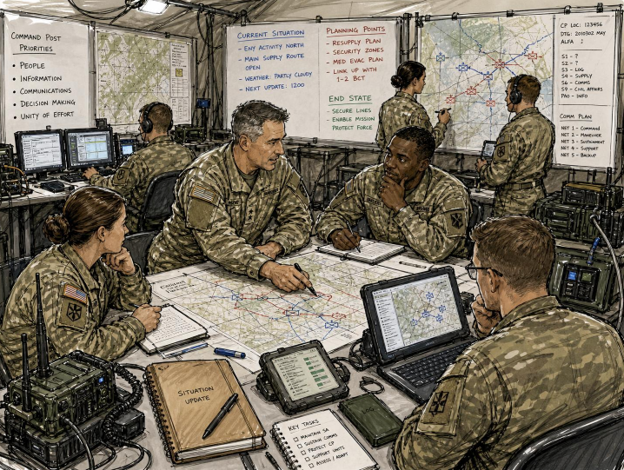
Illustration created with the assistance of ChatGPT, OpenAI, from a prompt developed by CCLA.
I’ve been following C.R.’s dispatches in CCLA’s Actually…Blog about the AI work underway in her company with great interest. They, along with some recent reporting on how the Army is beginning to experiment with the technology in training environments, got me thinking back to my own time in Special Forces — and what it might be like when something like AI shows up in a command post.
It might go something like this.
You don’t notice it at first.
The screens are the same. The maps are the same. The rhythm of the room doesn’t change much. What changes is the speed.
Information comes in faster. Options appear more quickly. Staff work that used to take hours starts to take minutes.
At first, it feels like an advantage — and it is.
Speed matters. I have spoken many times about the necessity of speed in decision-making. In the right hands, used well, it creates leverage. Those who do not have it, use it, or understand it will never gain that same power.
But after a while, something else becomes clear — particularly if you are the person in charge and accountable.
The pressure shifts.
It is no longer only on the staff to produce what is needed fast enough. It shifts to the commander to decide faster, often with more apparent certainty than the situation actually deserves.
The recommendations look clean. The logic is laid out. The options are structured. But the situation has not become simpler.
If anything, it becomes easier to mistake a well-presented answer for a right one.
That is where a commander’s developed intuition has to come into play.
Not intuition as guesswork. Not instinct detached from discipline. I mean the kind of intuition that has been developed over time through experience, study, repetition, failure, reflection, and accountability.
That kind of intuition asks deeper questions.
How was this data obtained?
Where did it come from?
What was included?
What was left out?
How was it analyzed?
What assumptions are built into the recommendation?
Does this course of action help us achieve the outcome we actually envision?
Those questions matter because AI can help you see more, but seeing more is not the same as understanding more.
AI can generate alternative courses of action. It can make strong recommendations. It can accelerate the work of the staff and sharpen the options in front of the commander.
But the choice is still not in the data.
The choice is in what the leader brings to it: mindset, skilled leadership knowledge, personal sensibilities, and the willingness to live with the consequences.
When you are the one who is accountable, it is on you to choose one of the options, reject them all, or develop a different one.
AI can help the commander gain leverage.
It should never be allowed to become a substitute for judgment.
General Fridovich served more than 37 years in the United States Army as an Infantry and Special Forces officer, retiring as the Army’s highest-ranking Green Beret.
Throughout his career, he led in complex international environments requiring strategic clarity, disciplined teamwork, and resilient leadership.
Since retiring from active duty, he has continued serving through mission-driven organizations focused on strengthening communities and supporting veterans, including America’s Warrior Partnership.
A lifelong teacher and mentor, General Fridovich brings a deep commitment to developing leaders and strengthening institutions by investing in people.